
Managing complex product information across suppliers, ERP systems and multiple sales channels requires more than spreadsheets.
Australian manufacturers, distributors and wholesalers manage increasingly complex product information. Technical specifications, product images, compliance documents and supplier data often sit across multiple systems.
Product Information Management (PIM) provides a central environment for managing, enriching and distributing product information. Pimcore can connect PIM with MDM, DAM and existing business systems.
What is PIM for distributors and wholesalers?
Product Information Management (PIM) is a system for collecting, organising, enriching and distributing product information across business systems and sales channels.
For distributors and wholesalers, PIM is particularly valuable because product information often originates from multiple manufacturers and suppliers, each using different formats, attributes and classifications.
A PIM platform provides a structured environment where this information can be standardised, validated and prepared for B2B eCommerce websites, dealer portals, digital catalogues and other channels.
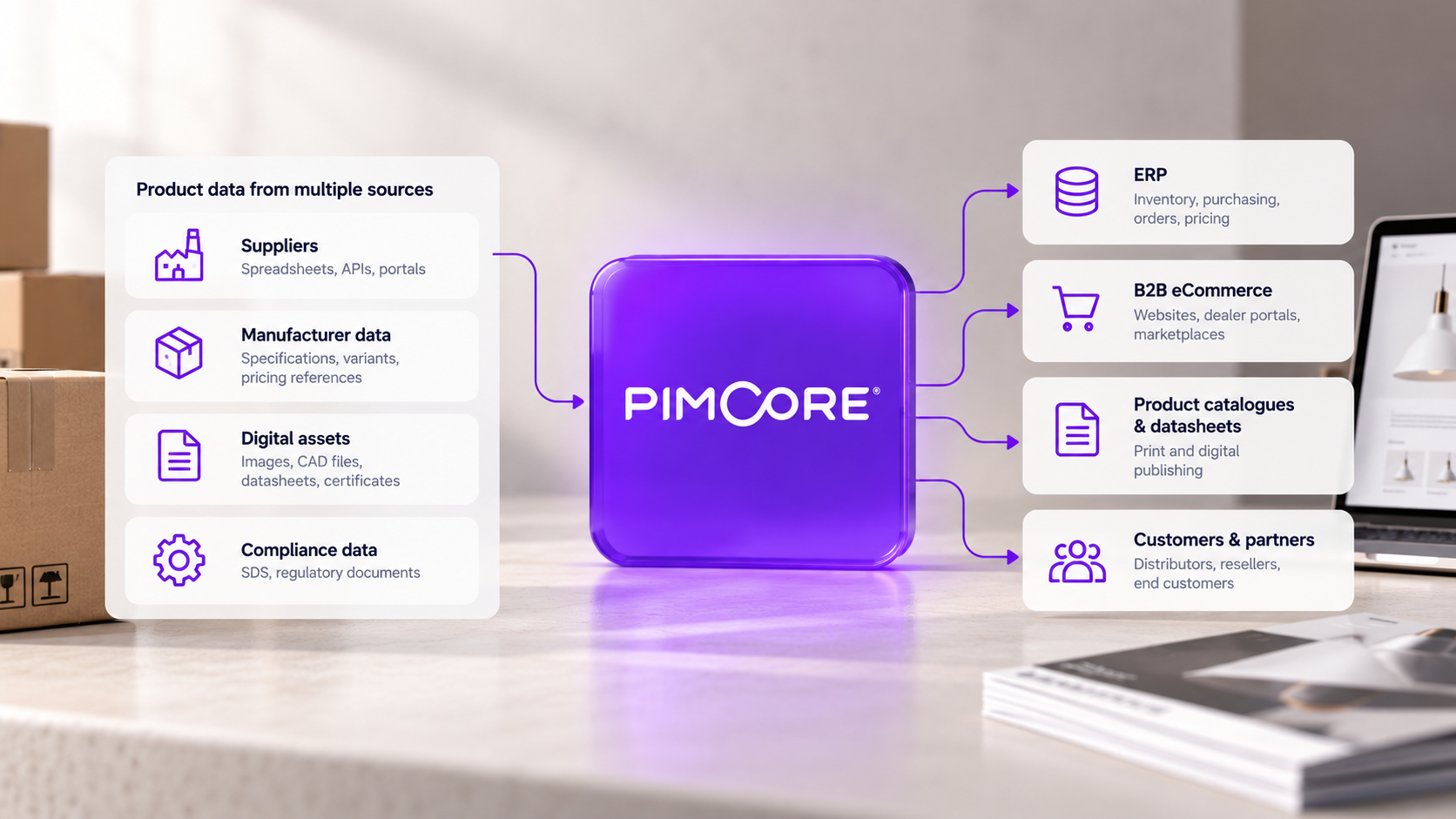
Why do distributors and wholesalers need PIM?
Distributors and wholesalers frequently manage product information created by other businesses. Supplier spreadsheets, PDF catalogues, structured feeds and APIs often contain different identifiers, measurement units and naming conventions.
Without a structured approach, teams spend considerable time correcting, matching and enriching product information before it can be used.
- Inconsistent supplier data: Different product identifiers, descriptions, formats and attribute names.
- Disconnected systems: Information spread across ERP, spreadsheets, websites and shared folders.
- Complex product relationships: Variants, accessories, replacement parts and compatibility.
- Multiple sales channels: Different content requirements for websites, portals and catalogues.
- Manual publishing: Repeatedly preparing datasheets and product catalogues.
- Incomplete content: Missing specifications, images or compliance documentation.
How does PIM work for a distribution business?
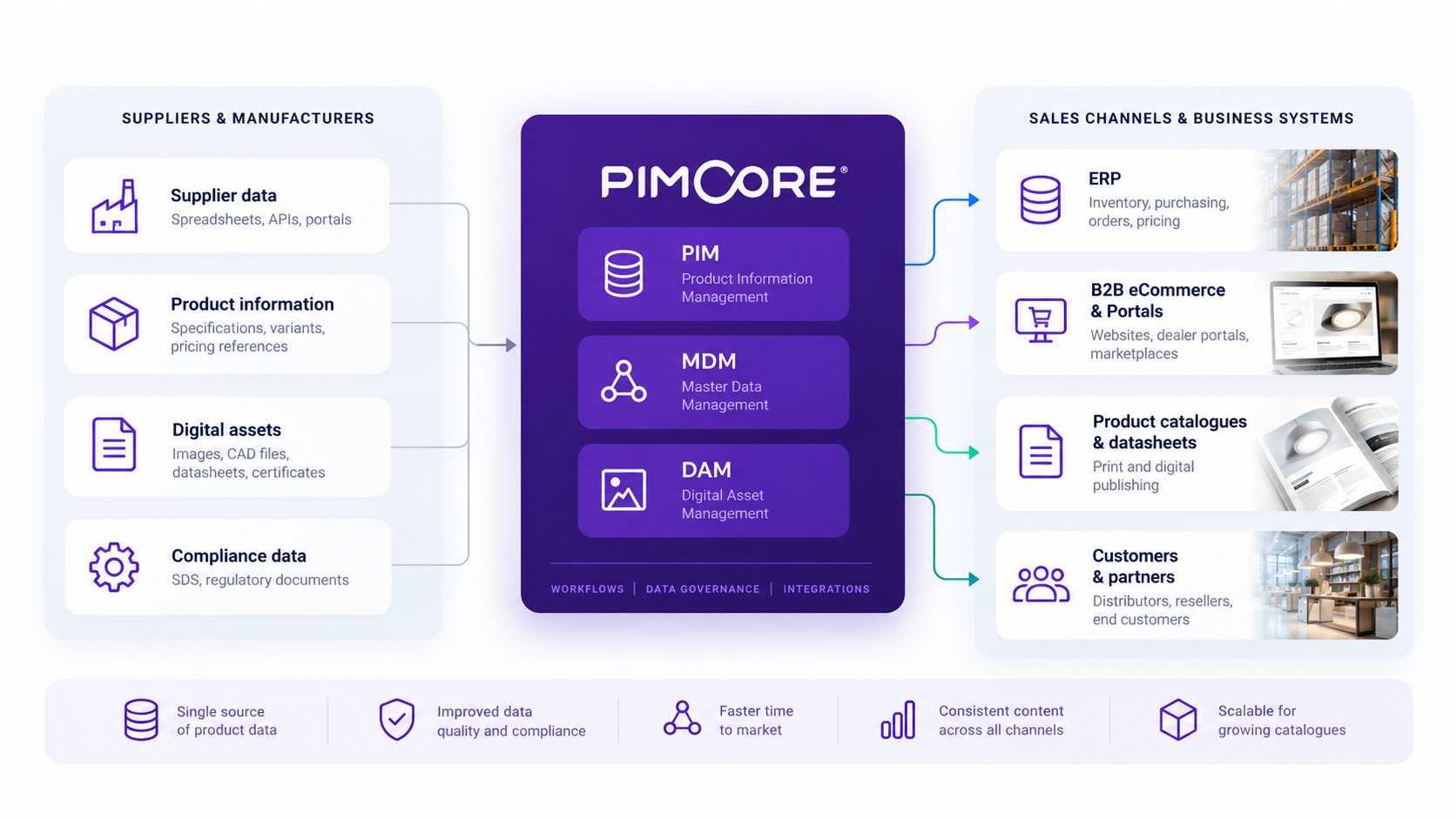
A PIM platform connects product information from different sources, standardises it and prepares it for distribution across business systems and customer-facing channels.
1. Collect supplier product data
Import product information from spreadsheets, supplier feeds, APIs and ERP systems.
2. Standardise and validate information
Map equivalent supplier attributes to consistent fields and flag missing or incorrect values.
3. Enrich product information
Add descriptions, specifications, classifications, relationships and digital assets through controlled workflows.
4. Connect ERP and business systems
Exchange relevant information with operational systems while keeping clear ownership of each data type.
5. Publish across multiple channels
Deliver approved content to B2B websites, dealer portals, marketplaces, datasheets and catalogues.
How does PIM support manufacturers, distributors and wholesalers?
Manufacturers typically create detailed specifications, product variants, certifications and distributor feeds. Distributors consolidate supplier information, manage product relationships and publish across channels. Wholesalers standardise supplier catalogues and support B2B sales.
These business models frequently overlap. A manufacturer may also distribute directly, while a wholesaler may import products under its own brand.
Why is Pimcore a good choice for distributors and wholesalers?
Pimcore is particularly well suited to businesses managing complex product information, multiple data sources and connected digital platforms. Its capabilities span Product Information Management (PIM), Master Data Management (MDM), Digital Asset Management (DAM) and digital experiences.
Flexible product data modelling
Configure product classes, attributes, hierarchies and relationships for technical or specialised catalogues.
Connected product information and digital assets
Associate product records with images, drawings, certificates and technical documentation through DAM.
ERP and legacy system integration
Connect existing systems using APIs, scheduled data feeds or custom integrations without necessarily replacing the ERP.
Multiple brands, markets and sales channels
Support different websites, customer groups and regional product presentations.
Automated product documentation
Provide structured content to templates and publishing workflows for datasheets and catalogues.
How are Australian businesses using Pimcore?
Stimulus has implemented Pimcore PIM/MDM, DAM and CMS solutions for Australian businesses across different industries. Examples include:
- SAL National (lighting): Managing technical product data, ERP integration, digital assets, product datasheets and catalogue publishing across multiple business channels.
- Liquip International (fluid handling equipment): Managing product information and digital content across approximately 10 connected websites, alongside a CCR warranty management portal supporting its distributor network.
- Trenton International (hospitality supplies): Managing product information, digital assets and website content for an extensive range of tableware, cutlery, glassware and hospitality products.
These projects demonstrate how Pimcore can support different business models, from technically complex manufacturing and distribution to wholesale product catalogues and multi-site digital platforms.
How does Pimcore integrate with ERP, eCommerce and other business systems?
Pimcore can manage detailed product content while exchanging information with ERP, eCommerce, CMS and other business applications through APIs, scheduled feeds or custom integrations.
An ERP generally remains responsible for inventory, purchasing, orders and transactional pricing. PIM complements the ERP rather than replacing it.
What is the difference between PIM, MDM and ERP?
PIM manages detailed product content for sales, marketing and publishing. MDM establishes consistency and control across shared master data, potentially including products, suppliers and customers. ERP manages operational and transactional processes such as inventory, purchasing and invoicing.
Is Pimcore suitable for Australian wholesalers of all sizes?
Pimcore can support wholesalers of different sizes, but it is not necessarily the best fit for every business. The decision depends on product complexity, integration requirements, publishing needs and resources rather than SKU count alone.
A simpler SaaS PIM may be more cost-effective for organisations with straightforward catalogues and limited integration requirements.
- Complex technical product attributes and relationships
- Multiple suppliers, brands or sales channels
- ERP and legacy system integrations
- Connected PIM, MDM and DAM requirements
- Automated product documentation and publishing
How do you choose the right PIM solution for your business?
Start by mapping where product information originates, who maintains it, how complex the product model is, which systems need integration and where the content must be published.
The right solution should also account for ongoing governance, support, maintenance and total cost of ownership.
- Where does the information originate? Map supplier files, ERP records and other sources.
- Who owns each data field? Define teams, approval processes and responsibilities.
- How complex is the catalogue? Review attributes, variants, relationships and documentation.
- Which systems need integration? Identify ERP, CMS, eCommerce, portals and publishing tools.
- How will the solution be maintained? Plan governance, support and future changes.
Why work with an Australian Pimcore implementation partner?
Successful PIM implementations require more than software configuration. They involve data modelling, system integration, workflows and an understanding of how the business uses product information.
Stimulus is a Sydney-based digital solutions agency specialising in Pimcore development, PIM, MDM, DAM and connected digital platforms for manufacturers, distributors and wholesalers.
Frequently asked questions
What is the best PIM software for Australian distributors?
There is no single best platform for every distributor. Pimcore is a strong candidate for complex product models and connected PIM, MDM and DAM, while simpler platforms may suit standardised requirements.
Can Pimcore manage product information from multiple suppliers?
Yes. Pimcore can be configured to import, map, validate and enrich supplier information, depending on the source formats and data quality.
Can Pimcore generate product catalogues and datasheets?
Pimcore can provide structured product data for automated publishing through suitable templates, integrations and workflows.
How does PIM help with AI readiness?
PIM helps establish consistent, structured product data that can support AI search and automation. Data governance, integration and application design remain essential.
Do wholesalers need PIM if they already have an ERP?
Not always. PIM can complement ERP where richer attributes, digital assets, supplier enrichment and multi-channel publishing are required.
Building a stronger product data foundation
For Australian manufacturers, distributors and wholesalers, product information connects suppliers, internal teams, business systems and customer-facing channels. A well-designed PIM solution can improve consistency, reduce repetitive work and support digital growth.
Looking to improve how your business manages product information? Stimulus helps Australian businesses build connected product data solutions using Pimcore. Talk to Stimulus about your product data, ERP integration and digital platform requirements.
Explore our Data Management services or read Which industries benefit most from PIM?